Debating AI

Depends on what I'm doing. Simplest would be boring spreadsheet v2.xls but there's a lot of stuff I revise a common file by a date or a course number/exam name so I will do something like assignments test #2.doc or assignments 1-17.doc.

If I am doing a home media project I will stick with the sequential version number after every major change, and usually print a video or wav file to match. With complex video you might also need scene and shot naming conventions. I learned a lot of this when I was working for a visual effects company and just ported that into my everyday workflow. When I first moved to Portland I had to create and manage a multimedia library so used those conventions.

Oh I should add the main thing is anytime something gets shared I stick a version number on it even if nobody else does, so I can track and reference changes without relying on MS tools to do it. It's also way easier to undo "fixes" other people suggest that I reject.
 
Also, I am right there with you. My current laptop has a local copy of Office installed on it. I don't intend on changing that when I upgrade to a new one here in a few months (I've been receiving various messages that my memory is low and my hard drive seems to be failing). I am old school like that; I like my USB drives! :):):)
USB is old school??
 
I'm not allowed to use USB drives. God if I could put files on a thumbstick or flash drive instead of logging into the cloud to pull up a powerpoint my Friday routine would be much happier (and quicker, with the bonus of there being no chance of accidentally staying logged in!)
 
USB is old school??
Well, considering that everything is moving towards being cloud-based, yes, I do consider USB to be "old school"...But, as long as the USB port is in existence, and is functionable, I will always carry my SanDisk Ultra USB 3.0 64GB flash drive with me wherever I go. And if I ever have to upgrade to another flash drive, I will gladly do so...:):):)
 

A snippet:

View attachment 14682

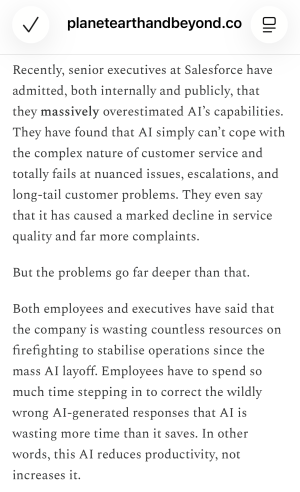
As many would suspect, "AI" remains a vague classification for technologies that are currently in search of a product. There will be narrow use cases that arise from this morass, but any business hoping to deploy "AI" as a cost-saving replacement for a human workforce is going to be profoundly disappointed. Perhaps these technologies will eventually evolve into the magic that overly optimistic tech executives see in them, but there's a lot of hype in the air, and I'm not convinced that "AI" is the future, at least not in the way it's often described. It seems more like an extension of the "ensh*ttification" that has plagued the modern internet across the last fifteen years or so.
 

The tech moguls keep fronting like Artificial General Intelligence is going to surpass human intelligence in naught plus one years meanwhile everything they turn over to AI is failing like you would expect it to if it were managed by an adolescent. It seems to me that human intelligence has a lot more intuition involved within it than most scientists have been willing to admit.
 
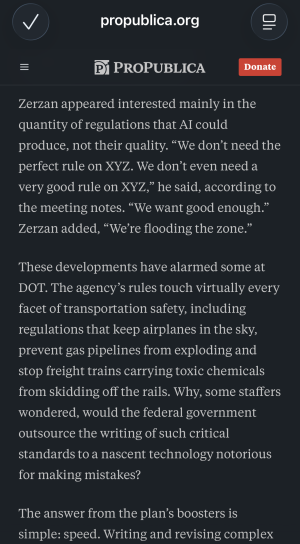
Insert Terminator theme here...good thing they want to shove it into every critical corner of the military!


The person, who was not authorized to speak publicly about the meeting and spoke on the condition of anonymity, said the tone of the meeting was cordial but Amodei didn't budge on two areas he has established as lines Anthropic won't cross -- fully autonomous military targeting operations and domestic surveillance of U.S. citizens.

The Defense Department did not immediately comment.

Amodei has repeatedly made clear his ethical concerns about unchecked government use of AI, including the dangers of fully autonomous armed drones and of AI-assisted mass surveillance that could track dissent.

We are truly living in the stupidest timeline right now.
 
Last edited:
I've actually been playing around with Claude (free) and finding I really enjoy the way it gets directions and helps me out with using software I am either new to, or looking to improve my workflow. I sure hope they don't back down.
 
I mentioned in the Sixth Man thread that I generated a workout tracker using Claude which has consolidated data from my old Fitbit Smart (now dumb, thanks for nothing Google!) scale, my new scale, and my fitness tracker, to give me one tool I can run on my desktop computer locally. It also has some features for logging photos, and I even built a page where I can upload a photo of skinny looking good me, and it will analyze it by date to determine when I might expect to be back in that level of shape. Mostly because I have a full wardrobe of nice clothes I can't currently wear and since going back to the office in 2022 I have been reluctant to buy nice clothes for a size I was unhappy with.

I had it do a few other things for me this week:
  • Help me build a Fender Studio Pro (formerly the Studio One DAW) template I can use when I am writing/recording songs
  • Built a web form that will track physical settings on my guitar that I can export and save in my song folders so I can make sure I move the dials back to the right places to do any re-tracking. I will probably do this for all instruments and settings down the road because it's really cool
  • I asked it for a musical theory analysis of a few songs I knew how to play on guitar. It suggested we write a song together, so I had it give me a few chord progressions to work with. I then recorded those chords with different positions and strum patterns and have been working on this song. I also started writing a topline melody around it by just singing giberish. It's really coming together. It's a fun exercise simply because I just said "ok, I'm going to use these chords and make a song with it". Really got my creative juices flowing.
  • I had it summarize Jeff Tweedy's How to Write One Song for me and create tools to practice his exercises. I read this book a few years ago and thought it was pretty interesting, but I checked it out from the library and only remembered a few of the exercises. My work colleague and I who have been experimenting with AI for work tasks mentioned that Gemini was useful for lit reviews so I also asked Gemini to do it. I thought it provided the best summary but I figured what the hell and also asked co-pilot, GPT, grok and perplexity to do the same. I then had Claude compile all into one master summary. I thought it was interesting that it analyzed all of the summaries and put that at the end of the summary - I'm going to copy that here because I think it is interesting showing what each tool may/may not be good at.
The six summaries agree on the book’s core thesis and most of its exercises, but differ in emphasis and in the tools each chose to highlight. The following observations are worth noting for anyone using this document as a reference.
  • Grok provided the most detailed technical account of the Word Ladder / Noun–Verb method, including specific step-by-step instructions not found in other summaries.
  • Gemini was the only summary to explicitly name the Cut-Up Technique and connect it to Tweedy’s broader surrealist influence, including the “Mumble Singing” or “Phonetic Faking” framing.
  • Copilot uniquely emphasised the Sensory Drills exercise and the “Appointment” scheduling method, as well as the most explicit account of simultaneous lyric-melody development.
  • Perplexity highlighted Rhythmic Borrowing and the normalisation of “stealing” from existing music as a legitimate compositional strategy.
  • ChatGPT added the most detail on the Ten-Minute Freewrite as distinct from automatic writing, and on the importance of concrete over abstract language in the editing phase.
  • Claude provided the most complete structural account of the book’s four-phase organisation and the most thorough treatment of the recording section.
No summary identified tools or exercises that directly contradicted others. The differences are additive: each analysis illuminates aspects the others underweighted. This document represents the fullest picture available from the synthesis of all six.
  • I asked it to build an Excel spreadsheet for me that would perform a mundane work task I do every week, which is to take a list of names assigned to an event, strip the numbers and last name, and randomize them to decrease the odds that students would see the same patients during their time with us. It took about 7 attempts to get it right, but I now can do this in about 10 seconds, where before I had to dump an outlook email into a plain text file and make sure it would separate the number and names into separate Excel tabs because it was too inconsistent. It also puts everything in the correct font for my final document by default so I can just cut and paste.
  • I had it start working on a long term project for me. This is a 4-5 year project that will probably take me to when I'd like to retire, and potentially also set me up nicely for post-retirement part time work. I am also going to have it help build custom reporting tools for me which I will then ask my vendor to build into our software.
  • I also started a retirement plan/checklist and while some of the data is bad I had it make a spreadsheet so I can put good info in there. But I did also find out a lot that I am sleeping on that I really need to do to prepare.
I'm by nature not an organized person. But I do know a lot of things. What I am finding is that using AI this way has been very good at helping me build organization tools that work for me based on my own knowledge. I guess this is vibe coding, and since my skill set is mostly shell and python scripting centered around file management, I am getting a lot out of this in very quick fashion and am strongly considering a subscription (and weighing asking my job to cover it). I've been very deliberate except in the book summary to not share real data with Claude, asking it for templates or using fudged numbers to get me basic info that I can then tweak to my own real data. All in all, when it comes to productivity and not just making funny cat videos or outright copyright theft, I am finding more ethical applications to be massive time savers and dare I say inspirational.

 
I mentioned in the Sixth Man thread that I generated a workout tracker using Claude which has consolidated data from my old Fitbit Smart (now dumb, thanks for nothing Google!) scale, my new scale, and my fitness tracker, to give me one tool I can run on my desktop computer locally. It also has some features for logging photos, and I even built a page where I can upload a photo of skinny looking good me, and it will analyze it by date to determine when I might expect to be back in that level of shape. Mostly because I have a full wardrobe of nice clothes I can't currently wear and since going back to the office in 2022 I have been reluctant to buy nice clothes for a size I was unhappy with.

I had it do a few other things for me this week:
  • Help me build a Fender Studio Pro (formerly the Studio One DAW) template I can use when I am writing/recording songs
  • Built a web form that will track physical settings on my guitar that I can export and save in my song folders so I can make sure I move the dials back to the right places to do any re-tracking. I will probably do this for all instruments and settings down the road because it's really cool
  • I asked it for a musical theory analysis of a few songs I knew how to play on guitar. It suggested we write a song together, so I had it give me a few chord progressions to work with. I then recorded those chords with different positions and strum patterns and have been working on this song. I also started writing a topline melody around it by just singing giberish. It's really coming together. It's a fun exercise simply because I just said "ok, I'm going to use these chords and make a song with it". Really got my creative juices flowing.
  • I had it summarize Jeff Tweedy's How to Write One Song for me and create tools to practice his exercises. I read this book a few years ago and thought it was pretty interesting, but I checked it out from the library and only remembered a few of the exercises. My work colleague and I who have been experimenting with AI for work tasks mentioned that Gemini was useful for lit reviews so I also asked Gemini to do it. I thought it provided the best summary but I figured what the hell and also asked co-pilot, GPT, grok and perplexity to do the same. I then had Claude compile all into one master summary. I thought it was interesting that it analyzed all of the summaries and put that at the end of the summary - I'm going to copy that here because I think it is interesting showing what each tool may/may not be good at.

  • I asked it to build an Excel spreadsheet for me that would perform a mundane work task I do every week, which is to take a list of names assigned to an event, strip the numbers and last name, and randomize them to decrease the odds that students would see the same patients during their time with us. It took about 7 attempts to get it right, but I now can do this in about 10 seconds, where before I had to dump an outlook email into a plain text file and make sure it would separate the number and names into separate Excel tabs because it was too inconsistent. It also puts everything in the correct font for my final document by default so I can just cut and paste.
  • I had it start working on a long term project for me. This is a 4-5 year project that will probably take me to when I'd like to retire, and potentially also set me up nicely for post-retirement part time work. I am also going to have it help build custom reporting tools for me which I will then ask my vendor to build into our software.
  • I also started a retirement plan/checklist and while some of the data is bad I had it make a spreadsheet so I can put good info in there. But I did also find out a lot that I am sleeping on that I really need to do to prepare.
I'm by nature not an organized person. But I do know a lot of things. What I am finding is that using AI this way has been very good at helping me build organization tools that work for me based on my own knowledge. I guess this is vibe coding, and since my skill set is mostly shell and python scripting centered around file management, I am getting a lot out of this in very quick fashion and am strongly considering a subscription (and weighing asking my job to cover it). I've been very deliberate except in the book summary to not share real data with Claude, asking it for templates or using fudged numbers to get me basic info that I can then tweak to my own real data. All in all, when it comes to productivity and not just making funny cat videos or outright copyright theft, I am finding more ethical applications to be massive time savers and dare I say inspirational.
Wow - good on you!

This is the kind of stuff I think AI should be used for. Not putting it in command of our military and letting it decide that launching nukes ain't all that bad. Although, I guess with some surviving solar panels, AI might be better off without the pesky humans?
 
Is it wrong that my first thought here was:

...I wanted to be...A LUMBERJACK! Leaping from tree to tree as they float down the mighty rivers of British Columbia!
Quite a few of my nicer pieces I need to slim down for are very urban lumberjack so you aren't wrong.
 
Going back to the beginning of the thread a lot of the discussion centered around education and the rampant plagiarism. Obviously I share those concerns. I thought I'd elaborate on my big project. A few years ago we noticed a problematic failure rate with Med students about to match into residency. My vision is to curb this from happening in the future, saving us from costly remediation exams and god forbid anyone failing with hundreds of thousands in debt by creating a standardized pool of questions from which to rate them on so we can intercept learners falling behind and get them the mentorship they need to execute these skills. All the data is there just need people to interpret it, produce the right reports, and convince the people who can fix it that its worth their time. I think these tools can actually fill in the gaps to show what the end result can look like and then hopefully the right people will all realize 90% of the work is already done and pitch in to complete it.

So yeah it is definitely creating educational hurdles but it might also create new solutions to problems that were deemed too big to take on.

FWIW if my son is telling the truth, his English teacher is now having them write with Chat-GPT and then having them fix everything wrong with it before they turn it in. 🤷‍♂️ Also my colleague who I have been bouncing AI ideas back and forth with is taking great delight at pointing out senior leadership's rampant use of using AI to write the entirety of their communications with us.
 
Herein lies the rub...

If we're talking about something hard science related such as Medical school testing where the goal is to train everyone to arrive at the same answers ... I still have some reservations (who gets to decide what the right answers are? What happens if perhaps a government and/or giant corporation actively discourages research and smuggles their own politically motivated hysteria into the model instead) ... but I can also see a utility in relying on these tools to diagnose and treat patterns of under-performance in the way you describe in areas of study where there is already a commonly accepted consensus.

My own experience is on the other end of the spectrum in creative writing, visual art, philosophy, and history which are all fields where the flattening of information to a standardized model is actively destructive to the discipline itself. The goal in all of these fields is not to arrive at a consensus, it's to explore the possibilities of human experience from every angle possible, until we start to create a more complete picture of the truth in aggregate form. AI models can approximate ambiguity by summarizing some of the most popular theories but they are not going to help you develop an intuition for which of those theories you agree with and why.

If I ask the AI model what happened during the U.S. Civil War for instance, whose point of view am I going to get? What about the Mexican-American war? What about the Armenian Genocide? The real work of engaging with history and philosophy is in doing the reading yourself, sometimes re-reading over and over on the really difficult topics, and allowing your neurons to bounce off of that information and draw your own conclusions. Asking a model to read and react for you is not even in the same ballpark as real critical analysis. It's not even in the parking lot. It's something like sitting at home on your couch and pretending you've hit a home run. But baseball is a game. The normalization of false impressions of history can, and in fact already does, have dire consequences for all of us.

I'll put aside visual art because I think it ought to be self-evident how generative AI is the ice-nine of all visual art. (From Kurt Vonnegut's book Cat's Cradle for those who haven't read it -- ice-nine is a fictional laboratory synthesized form of H20 which, once invented, turns all liquid water into ice, instantly bringing about global apocalypse).

And then we get to the topic of writing. I understand that teachers are in a bit of a lose-lose situation here. I imagine it must be hard enough to get these kids out of their phones long enough to even communicate with them verbally and the odds of holding back the global tide of AI business and keeping it out of English (and other language) classes entirely long enough to teach them how to write without it has got to be impossible so why not acknowledge it and work with it instead. Perhaps the consequences of losing the skill of writing without language learning tools as a crutch is not quite as dire as the death of critical thinking would be, but as a writer I cannot say this enough to people .... if you are using AI at any step in the process, you will never learn the skill of writing. And if you already have the skill and think you can shortcut your way out of doing real work, you're like a body builder who has stopped lifting weights. You're not going to keep all of that muscle if you let it atrophy.

There is no maybe about it in my opinion. It flat out is not possible to write an original work without sitting down with a pen and paper or a typewriter or a computer program and keyboard and painstakingly filling up blank page after blank page by putting one word after another. Writing could alternatively be described as "idea synthesis" and without generous inputs of time and mental focus no synthesis is going to take place. I would liken it to climbing a mountain. Here comes Mr. OpenAI to build a chairlift to get you to the top of the mountain where you can take your pictures of the view like everyone else and maybe convince yourself because you've seen the top that you've experienced all there is to experience of the mountain. But anyone who has climbed a mountain from bottom to top can tell you, standing on top is like 1% of the entire experience and it is meaningless if you don't do the other 99%. What you are learning with AI tools is revising. Still an important skill, still part of the process, but revision is not going to produce a work of startling originality which will ignite the imagination of millions.

Now maybe the goal of your average English (French, Spanish, Russian, etc.) teacher is not to train the next Tolstoy, it's to make sure these kids pass and reach the next grade. Yes I understand that we all have jobs because we need them to survive and not everyone's job is an all-consuming passion. But dammit, someone needs to at least warn these kids that they are not helping themselves by skipping out on hard work. What they are actually doing is reversing the clock on labor equality back 200 years to when there was an ownership class and everyone else was an unskilled grunt. The ultimate culmination of training the next generation only how to use AI tools is a widening of income inequality and a permanent underclass.
 
No content or materials will be AI generated. It is all back end stuff that we don't have staff or resources to create the necessary evaluation tools needed where AI can assist with generating them. I'd rather not get more specific than that, but I will say there won't be any new resources coming our way until 2029 at the earliest. :mad:

I am going very far out of my way to keep it simple, probably Excel sheets with some vbasic scripting to pull data from multiple reports into a cumulative report that our current software doesn't support.
 
Back
Top