Race to the Bottom thread

Maybe not but it also speaks to the absolute strength of this class that there’s an argument for him going third overall.

Yussir, good year to be doo doo, that's for sure!

I've been reading that this one could be 6-7 deep with potential franchise changers.
 
it ends tanking becaue the lottery becomes a blind draw between 16 teams (8 in each conference - i should keep saying, "this is a plan for AFTER expanision boosts each conference to 16 members")

ok?

what don't you like about it?
I've already indicated what I don't like about it...It devalues the 2nd half of the schedule.
 
I've already indicated what I don't like about it...It devalues the 2nd half of the schedule

alright, let's look at it from your perspective:

you say, "it devalues the 2nd half of the schedule"

in return for:

it eliminates tanking.

IF

it were a one for one trade

and you devalued the 2nd half of the schedule in RETURN for "eliminating tanking"

would that be a fair trade?

mind you, i don't agree that the second half of the schedule is devalued by this plan (none of those bottom eight team - four in each conference - are going to make the playoffs anyway) but if the second half of the schedule would be devalued, WOULD you take that tradeoff to END "tanking"?

(i THINK your answer would be "yes" BUT...)

-----------------------------------------------------------------------------------------------------------------------------

who is disadvantaged by the devaluation of the last portion of the schedule?

not the eight playoff teams in each conference - they are named at the all-star break with the seedings to be determined at the close of the regular season

and not the top four non-playoff teams in each conference - they have a potential way to "play in" (to the eighth spot).

so, are the bottom four non-playoff teams in each conference disadvantaged?

well, yes, they are disadvantaged, but it is a disadvantage of their own making (they did not build a good team)

and it is not the "second half of the schedule" that is devalued, but the bottom teams' chances of getting a high pick in the lottery.

they lose a (kind of) "guarantee" that they will receive a "high pick" - except last year, the #13 team got the first pick

but those bottom four teams (currently - actually, only the bottom three) can only be pushed down so far (#1 COULD go to four, #2 to 5, ect)

but i still don't see how they are disadvantaged by the "devaluation of the second half of the schedule".

except that (at worst) they COULD wind up with pick #16 - "could" but not "are going to" - it's a "chance" - they could also get the first or second pick.

so, would you prefer to "protect" those bottom three lottery teams (some of which may be "tanking") in order to "value" the second part of the season?


do you want the bottom eight teams to receive the top eight picks (forget that they caused this problem themselves)?

but to get that outcome, you have to have a system that encourages "tanking" (because if you are in the bottom eight, you are "guaranteed" a pick in the 1-8 range - unless you just want to protect "the top (bottom) three teams.

this is a good draft year (5-7 "valuable" picks)

but keegan's year is looking like only the top three teams truly benefitted from the system (and at least one of them tanked to get there)

so, if three teams benefit from the system we have, how big is that devaluation?


perhaps it could be mitigated by an annual "dispersal draft" where the "best" teams can only "protect" seven or eight players and the "bad" teams can protect eight or nine players.

in any dispersal draft, you select in inverse order of the records (final season standings)

if you think they are "disadvantaged", would "being allowed to select TWO players (from other teams) before a playoff team even got one selection", would that "even things up"?

but i really want to hear a cogent explanation of how the "second half of the season is devalued"

start by saying, "the second half of the season is devalued in THIS particular way."

 
alright, let's look at it from your perspective:

you say, "it devalues the 2nd half of the schedule"

in return for:

it eliminates tanking.

IF

it were a one for one trade

and you devalued the 2nd half of the schedule in RETURN for "eliminating tanking"

would that be a fair trade?

mind you, i don't agree that the second half of the schedule is devalued by this plan (none of those bottom eight team - four in each conference - are going to make the playoffs anyway) but if the second half of the schedule would be devalued, WOULD you take that tradeoff to END "tanking"?

(i THINK your answer would be "yes" BUT...)

-----------------------------------------------------------------------------------------------------------------------------

who is disadvantaged by the devaluation of the last portion of the schedule?

not the eight playoff teams in each conference - they are named at the all-star break with the seedings to be determined at the close of the regular season

and not the top four non-playoff teams in each conference - they have a potential way to "play in" (to the eighth spot).

so, are the bottom four non-playoff teams in each conference disadvantaged?

well, yes, they are disadvantaged, but it is a disadvantage of their own making (they did not build a good team)

and it is not the "second half of the schedule" that is devalued, but the bottom teams' chances of getting a high pick in the lottery.

they lose a (kind of) "guarantee" that they will receive a "high pick" - except last year, the #13 team got the first pick

but those bottom four teams (currently - actually, only the bottom three) can only be pushed down so far (#1 COULD go to four, #2 to 5, ect)

but i still don't see how they are disadvantaged by the "devaluation of the second half of the schedule".

except that (at worst) they COULD wind up with pick #16 - "could" but not "are going to" - it's a "chance" - they could also get the first or second pick.

so, would you prefer to "protect" those bottom three lottery teams (some of which may be "tanking") in order to "value" the second part of the season?


do you want the bottom eight teams to receive the top eight picks (forget that they caused this problem themselves)?

but to get that outcome, you have to have a system that encourages "tanking" (because if you are in the bottom eight, you are "guaranteed" a pick in the 1-8 range - unless you just want to protect "the top (bottom) three teams.

this is a good draft year (5-7 "valuable" picks)

but keegan's year is looking like only the top three teams truly benefitted from the system (and at least one of them tanked to get there)

so, if three teams benefit from the system we have, how big is that devaluation?


perhaps it could be mitigated by an annual "dispersal draft" where the "best" teams can only "protect" seven or eight players and the "bad" teams can protect eight or nine players.

in any dispersal draft, you select in inverse order of the records (final season standings)

if you think they are "disadvantaged", would "being allowed to select TWO players (from other teams) before a playoff team even got one selection", would that "even things up"?

but i really want to hear a cogent explanation of how the "second half of the season is devalued"

start by saying, "the second half of the season is devalued in THIS particular way."
I've already indicated why I believe the 2nd half of the season would be devalued by your "master plan". I don't need to repeat myself.
 
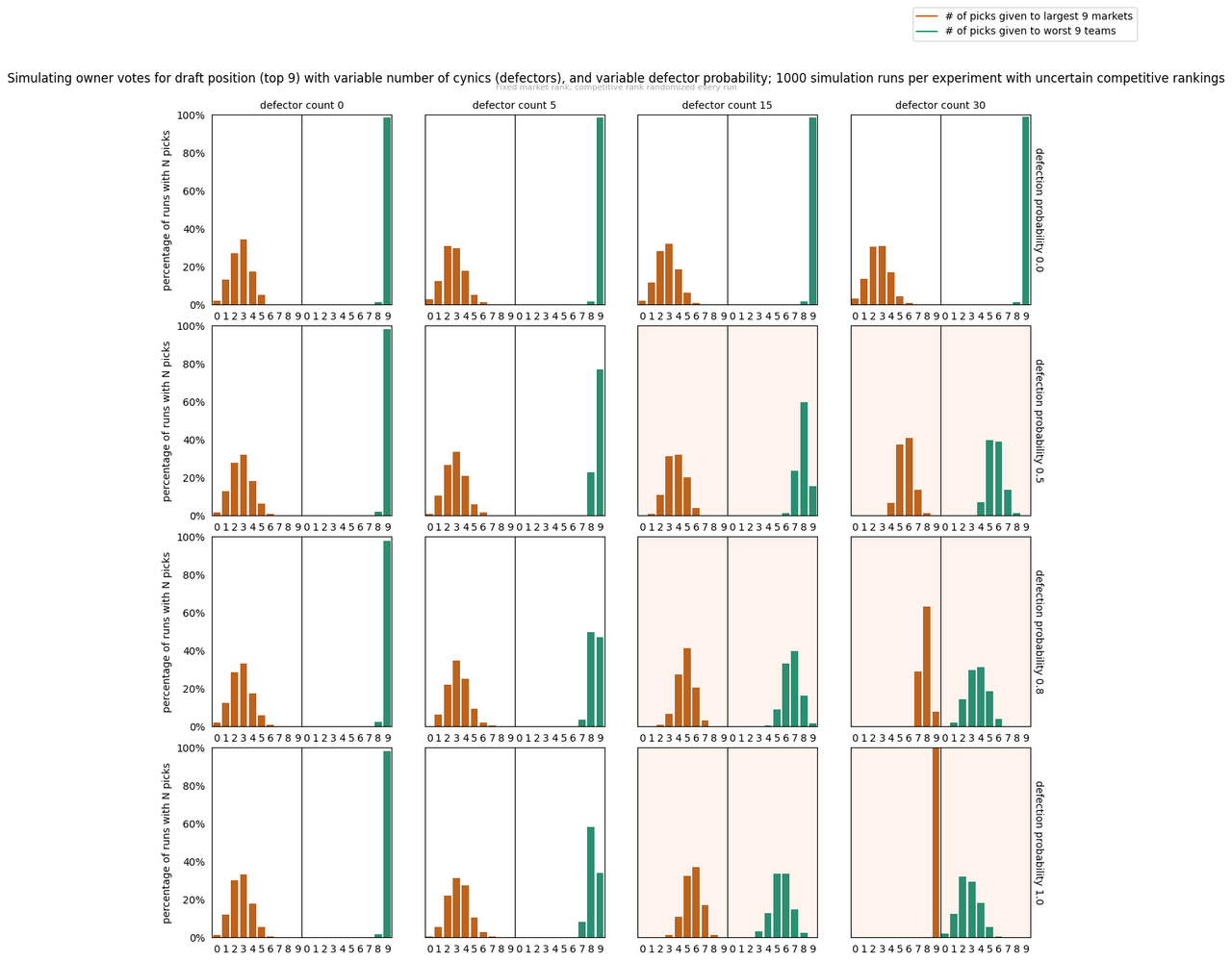
I implemented a simulation of this, where some owners are motivated to distribute draft picks by competitive rank, and some proportion of the rest are motivated to rank by some other motive. (in this case I used tv market size, but it's conceptually applicable to any alternative ranking.)

I rendered the simulation into a parameter grid, so readers can plug in their own values for how many cynical owners, and cynical we assume they are. I highlighted the parameter combinations that seem plausible to me.

The simulation worked by having simulated owners composing a ballot of a ranked list of teams and the overall score being calculated similarly to the MVP vote. I added some shuffling for each owner of the "optimal" competitive order to represent the order being somewhat subjective.

(For instance, the plot with defector count 15, and defection probability 0.5 represents half of the owners being completely earnest in creating their ballot, with the remaining 15 when making their ballot decide half the time to pick the worst team, and the other half of the time they pick the largest media market)

 
Last edited:

Makes sense I guess. As much as we might want the Kings to completely blow it up down to the studs, the allure of having Peterson (currently putting up one of the most elite off-ball shooting seasons in NCAA history) or AJ playing off of Domas with them surrounded by actual sizeable guys like Keegs/Hunter/Precious might be too much for Vivek to resist (selfishly, I’d kinda want to see it too)
 
Last edited:

Makes sense I guess. As much as we might want the Kings to completely blow it up down to the studs, the allure of having Peterson (currently putting up one of the most elite off-ball shooting seasons in NCAA history) or AJ playing off of Domas with them surrounded by actual sizeable guys like Keegs/Hunter/Precious might be too much for Ivey to resist (selfishly, I’d kinda want to see it too)

Again, as we said at the deadline;

I'm sick of being the little brother to the rest of the league and just bleeding talent "because". Domas is an incredibly valuable player and the offers he was getting were laughable; fine, we'll keep him. I think he's far more valuable being a true safety valve for a young rookie stud that can quickly help his development than us shuttling him out of here for 20 cents on the dollar. That Barrett+Poeltl+2nds offer is even less that TOR was reportedly offering.

Every single talented player that's eventually been shuttled out of town... we've lost the trade. Tyreke, IT2, Cousins, Fox. Cannot happen with Domas
 
Not shopping Domas would be mistake but keeping him for next season isn't the worst thing. The problem is they have to move him before '27 to maximize cap space potential. It could work and I do like the idea of Boozer and him but they probably don't see the potential there. Even if Boozer is just learning from Domas for a year that would a good thing IMO. The thing about this is there will be no gap year like this again. If they keep Domas and run with Hunter/Keegan in a win now and push the young guys back this is literally going to be the same basic thing they did to Fox in year 1. And if it ends up being this bad? Perry will be out sooner than later, bank on it. The Kings will probably blow their MLE on a win now vet, complicate a rebuild again, and end up paying the price per usual. If they want to "run it back", then run it back. No more Schroders. I swear this franchise is a like a crack addict lol. Just can't get off.
 
My plan would have been to move Domas ASAP and tank for 2-4 more years, (to wait and see if the guy we got was an actual winner); but that was before the League started making noise about disincentivizing tanking.

I don't know what the new plan should be. I think Domas is too flawed for playoff basketball, but he can be very productive during the regular season. Flattening the lottery would make him less detrimental to the team's long term success.
 
I highlighted the parameter combinations that seem plausible to me.
If you think that the plausible combinations include a minimum of 50% of owners (or even 100%!) voting to send high picks to large media markets regardless of actual team need, I don't know what to say. You've literally highlighted the simulation where every small market team votes to give all the top 9 picks to large markets. "Plausible," you think.

If all 30 NBA owners wanted high draft picks to go to large markets, there wouldn't be a lottery, since they already make the rules. They would just distribute draft picks by media market size. They would all be in agreement...
 
Back
Top