Race to the Bottom thread

How can that be? I thought that getting a top 3 pick was so uber-important that franchises folded if they couldn't attain that lofty goal? /s

The chart posted above certainly disagrees with your assertion.

View attachment 14731
I don't understand the point you're making

I'm showing evidence that the best that draft experts have managed is that the top 5 has the best player most of the time, and the #1 pick has the best player more often than any other pick.

That's valuable information to be sure, but I'm skeptical that draft expertise or draft incompetence really matters much in the aggregate.
 
I don't understand the point you're making

I'm showing evidence that the best that draft experts have managed is that the top 5 has the best player most of the time, and the #1 pick has the best player more often than any other pick.

That's valuable information to be sure, but I'm skeptical that draft expertise or draft incompetence really matters much in the aggregate.
Sorry, I went back and read your post again and realized I somewhat glossed over it the first time and missed the "gist". My bad. That's what I get for trying to read this and watch mandated work safety training videos on "slips/trips/falls" (clean up spilled liquids, pick up trip hazards, don't fall in a hole - duh) and similar stuff at the same time.

However, I thought the wailing and gnashing of teeth everyone seems to have if we don't get a top 3 pick is rather humorous considering your chart shows that the #1 pick is most important (duh, that's where you get the LeBrons and the Wembys and the Duncans) and after that it's somewhat of a crapshoot. Which is what I've been saying all along. Then the table posted earlier shows that the best two picks (by VORP) are 3 and 4. :)
 
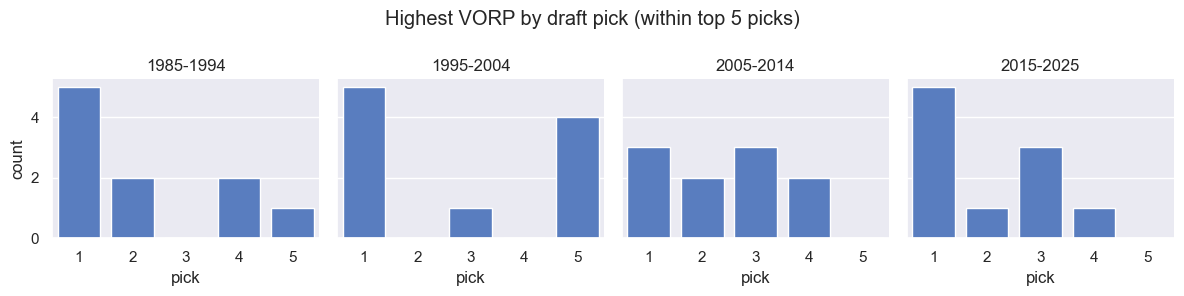
Here's a plot showing where the best player in the top 5 for every year was picked.

View attachment 14730

What this shows is that since 1985, the player in picks #2-#5 are about equally likely to be the best player in a class. And it's slightly more likely that the best player comes in picks 2-5 than #1.

Given how flat the curve is from 2-5, my interpretation of this is, that in the top 5 picks, once you get past the first pick; it all basically comes down to probability and noise, even for the professional front offices that hire scouts and people to work players out. If draft expertise was relevant, then you'd expect to see pick 2 have a higher count than pick 3, and so on, a downwards curve instead of a cliff and valley.

Which makes this all a rather pointless exercise in pedantry since the best we can guarantee ourselves is a 14% chance of the #1 pick even with the worst record in the league. We may go into the lottery with the 3rd best odds only to see the team with the 10th best odds pick #1. In which case we should have won more games, I guess? If we knew in advance what the lottery draw was going to be then we could position ourselves strategically into those spots. Instead all we're trying to do is mitigate the damage of a bad lottery draw which makes sense up to a point but not as much sense as just saying toss it all, I'm going to focus on scouting instead since that's how I actually can positively impact my draft outcome. Assuming we finish the season with one of the 5 worst records in the league we'd still have a far greater chance of picking 5-8 than we would of picking #1 so I will continue to argue that scouting is far more important than losing all of your games.

I find probability in general to be counter-productive to good decision making (no offense). I don't really want to go into detail why... but to be brief, I think probability assumes an outdated model of how the universe works that I personally disagree with. Summing up every pick ever made and showing the VORP distribution of those players strikes me as the most wrong-headed way a person could approach the draft. I suppose if basketball players were all exactly the same then there might be something to this but we're not just rolling dice here, what we're doing is closer to a logic puzzle: (Player X at 17 years old => Player X at 18 years old => Player X at 19 years old => ??) If you were to spend your time watching basketball players you could start to identify what qualities the successful NBA players have in common and what qualities the unsuccessful NBA players have in common. That would lead to a dataset which might actually be useful and more importantly it would force you to formulate a testable hypothesis and ultimately a theory which can be used to guide your decision making.
 
Sorry, I went back and read your post again and realized I somewhat glossed over it the first time and missed the "gist". My bad. That's what I get for trying to read this and watch mandated work safety training videos on "slips/trips/falls" (clean up spilled liquids, pick up trip hazards, don't fall in a hole - duh) and similar stuff at the same time.

Thanks for taking the time to give it a second look. 👍
However, I thought the wailing and gnashing of teeth everyone seems to have if we don't get a top 3 pick is rather humorous considering your chart shows that the #1 pick is most important (duh, that's where you get the LeBrons and the Wembys and the Duncans) and after that it's somewhat of a crapshoot. Which is what I've been saying all along. Then the table posted earlier shows that the best two picks (by VORP) are 3 and 4. :)


I'm thinking of this chart that I posted earlier as context
1763130911499.png


These charts aren't quite measuring the same thing, but roughly speaking, you can think of the #1 pick as being a little less than half of the first column of this chart. Picks 2-5 are significantly more valuable than what comes afterwards. Yeah, I'm saying that picks 2-5 are basically random, but that the odds fall off a cliff after that.
 
Last edited:
Which makes this all a rather pointless exercise in pedantry since the best we can guarantee ourselves is a 14% chance of the #1 pick even with the worst record in the league. We may go into the lottery with the 3rd best odds only to see the team with the 10th best odds pick #1. In which case we should have won more games, I guess? If we knew in advance what the lottery draw was going to be then we could position ourselves strategically into those spots. Instead all we're trying to do is mitigate the damage of a bad lottery draw which makes sense up to a point but not as much sense as just saying toss it all, I'm going to focus on scouting instead since that's how I actually can positively impact my draft outcome. Assuming we finish the season with one of the 5 worst records in the league we'd still have a far greater chance of picking 5-8 than we would of picking #1 so I will continue to argue that scouting is far more important than losing all of your games.
The point is you have to go into rebuilding with the expectation that it's going to be a multi-year exercise, with both hits and misses along the way. None of us has much (any?) impact on how many games the Kings win in any case. Figuring out reasonable expectations can be useful psychologically though.

I find probability in general to be counter-productive to good decision making (no offense). I don't really want to go into detail why... but to be brief, I think probability assumes an outdated model of how the universe works that I personally disagree with. Summing up every pick ever made and showing the VORP distribution of those players strikes me as the most wrong-headed way a person could approach the draft. I suppose if basketball players were all exactly the same then there might be something to this but we're not just rolling dice here, what we're doing is closer to a logic puzzle: (Player X at 17 years old => Player X at 18 years old => Player X at 19 years old => ??) If you were to spend your time watching basketball players you could start to identify what qualities the successful NBA players have in common and what qualities the unsuccessful NBA players have in common. That would lead to a dataset which might actually be useful and more importantly it would force you to formulate a testable hypothesis and ultimately a theory which can be used to guide your decision making.
The charts I posted don't do anything to help evaluate players, and that's not the intention. What they do is to define the standard for how effective professional talent evaluation is.

So of course, scouts are watching players, making projections based on their own values and all that. And front offices are hiring the best evaluators they can. The point I'm making is that even with front offices hiring the best talent evaluators they can, the standard for performance is quite low. The top 5 is chosen pretty well; and the #1 pick is the best player somewhat less than 50% of the time. Past that, the experts aren't generating insight significantly better than static (though expertise does seem to reassert itself a bit when ranking picks 6-15)

Which isn't to say that talent evaluation is useless, it's possible that some front offices are better at talent evaluation than others, (I suspect we don't have enough data to validate this.) I'm pretty sure I would consistently pick LeBron and Wemby at #1, but past that, I'm sure I'd be much worse than a pro at picking the best out of the top 5, and probably worse still at picking the top 5 out of a class of 60.

How it matters for decision-making depends on what types of decisions you are making. It's not helpful for picking players, but it is useful for evaluating if your pickers are up to standard. It's also useful for deciding whether a rebuild is worth it given the expected return, and how much to value low lottery picks relative to other transactions.
 
Last edited:
The point is you have to go into rebuilding with the expectation that it's going to be a multi-year exercise, with both hits and misses along the way. None of us has much (any?) impact on how many games the Kings win in any case. Figuring out reasonable expectations can be useful psychologically though.


The charts I posted don't do anything to help evaluate players, and that's not the intention. What they do is to define the standard for how effective professional talent evaluation is.

So of course, scouts are watching players, making projections based on their own values and all that. And front offices are hiring the best evaluators they can. The point I'm making is that even with front offices hiring the best talent evaluators they can, the standard for performance is quite low. The top 5 is chosen pretty well; and the #1 pick is the best player somewhat less than 50% of the time. Past that, the experts aren't generating insight significantly better than static (though expertise does seem to reassert itself a bit when ranking picks 6-15)

Which isn't to say that talent evaluation is useless, it's possible that some front offices are better at talent evaluation than others, (I suspect we don't have enough data to validate this.) I'm pretty sure I would consistently pick LeBron and Wemby at #1, but past that, I'm sure I'd be much worse than a pro at picking the best out of the top 5, and probably worse still at picking the top 5 out of a class of 60.

How it matters for decision-making depends on what types of decisions you are making. It's not helpful for picking players, but it is useful for evaluating if your pickers are up to standard. It's also useful for deciding whether a rebuild is worth it given the expected return, and how much to value low lottery picks relative to other transactions.
I think one point to evaluating talent is some major shifts have occurred…

1) international players are no longer under valued. Tony Parker isn’t falling to Round 2, Peja isn’t going 16th. For sometime US teams had a bias against foreign players and young players. No longer does that bias exist. A lot of the big misses people cite were foreign players.

2) players entering the draft younger have increased the misses. Teams are having to project lumps of clay versus finished products. That has made projection harder and some older guys slip.

3) Anaytics have exploded. NBA front offices now have entire departments running correlations on known traits and future success. As a result items like free throw shooting is more predictive of future 3 point success than 3 point percentage. The obsession with length both in terms of wingspan and standing reach.
 
The point is you have to go into rebuilding with the expectation that it's going to be a multi-year exercise, with both hits and misses along the way. None of us has much (any?) impact on how many games the Kings win in any case. Figuring out reasonable expectations can be useful psychologically though.


The charts I posted don't do anything to help evaluate players, and that's not the intention. What they do is to define the standard for how effective professional talent evaluation is.

So of course, scouts are watching players, making projections based on their own values and all that. And front offices are hiring the best evaluators they can. The point I'm making is that even with front offices hiring the best talent evaluators they can, the standard for performance is quite low. The top 5 is chosen pretty well; and the #1 pick is the best player somewhat less than 50% of the time. Past that, the experts aren't generating insight significantly better than static (though expertise does seem to reassert itself a bit when ranking picks 6-15)

Which isn't to say that talent evaluation is useless, it's possible that some front offices are better at talent evaluation than others, (I suspect we don't have enough data to validate this.) I'm pretty sure I would consistently pick LeBron and Wemby at #1, but past that, I'm sure I'd be much worse than a pro at picking the best out of the top 5, and probably worse still at picking the top 5 out of a class of 60.

How it matters for decision-making depends on what types of decisions you are making. It's not helpful for picking players, but it is useful for evaluating if your pickers are up to standard. It's also useful for deciding whether a rebuild is worth it given the expected return, and how much to value low lottery picks relative to other transactions.

Professional talent evaluators aren't the ones making the picks, they're making recommendations to someone else who probably is only going to have that job for 2-5 years. My theory is that the failure isn't in the evaluation process, it's in the decision-making.

I could perform the same exercise with movie productions -- how many movies are released in a year vs. how many of them make money -- and come to the same conclusion you have that talent is essentially worthless and the only way to have success is to flood the market with tons of product and hope that you have enough successes to turn a profit. Would you then say that it makes no difference who I hire to write, direct, and star in a movie if the end goal is profitability? If you zoom out far enough, of course it all looks like statistical noise. You're taking a snapshot from outer space when you should be taking it from across the street.

I don't think it's at all useful to assign value to a draft slot in the abstract. The value of any draft slot is directly tied to the specific players you have an opportunity to acquire with that pick. A pick in the 20s-30s three years from now is worth almost nothing to me. If there's a specific player in this draft that I want and they are available at #22 then that pick suddenly is quite valuable. In that regard, I think actual talent is just as important as it always has been. Unfortunately, everyone is so obsessed with data analysis now that we seem to have forgotten how to make actual decisions instead of outsourcing the cognitive load to machines which are incapable of higher level intelligence. The more front offices look at the draft process statistically and allow this information to supersede one-to-one talent evaluation, the worse their results are going to be.
 
Professional talent evaluators aren't the ones making the picks, they're making recommendations to someone else who probably is only going to have that job for 2-5 years. My theory is that the failure isn't in the evaluation process, it's in the decision-making.
That may be true, perhaps front offices are systematically hiring professionals and ignoring them. Seems to me that anyone who can consistently rank #2-#5 better than random can make a good case for getting some of that talent evaluator money. (And if you're wrong, the public will blame your boss. What a sweet gig!)
I could perform the same exercise with movie productions -- how many movies are released in a year vs. how many of them make money -- and come to the same conclusion you have that talent is essentially worthless and the only way to have success is to flood the market with tons of product and hope that you have enough successes to turn a profit. Would you then say that it makes no difference who I hire to write, direct, and star in a movie if the end goal is profitability? If you zoom out far enough, of course it all looks like statistical noise. You're taking a snapshot from outer space when you should be taking it from across the street.
Another analogy, hooray. I don't know the movie business, but it seems like even if you make the producer wear a blindfold and throw darts at the board to pick movies, the problems are still structurally different. The NBA draft is a limited number of discrete choices to fill a limited number of roster spots, compared to a near infinite continuum of possibilities for how to divide a budget amongst movie projects. What's the value of the analogy? Why can't we just talk about the thing that we're talking about? (Movie making isn't inherently more transparent than basketball roster management)

I don't think it's at all useful to assign value to a draft slot in the abstract. The value of any draft slot is directly tied to the specific players you have an opportunity to acquire with that pick. A pick in the 20s-30s three years from now is worth almost nothing to me. If there's a specific player in this draft that I want and they are available at #22 then that pick suddenly is quite valuable. In that regard, I think actual talent is just as important as it always has been. Unfortunately, everyone is so obsessed with data analysis now that we seem to have forgotten how to make actual decisions instead of outsourcing the cognitive load to machines which are incapable of higher level intelligence. The more front offices look at the draft process statistically and allow this information to supersede one-to-one talent evaluation, the worse their results are going to be.
I think there is a valid criticism of my approach buried in there, in that I assume that teams are attempting to draft the "best player available", when instead they might be motivated to find the "best fit." I make no assertions on the value of expertise for the "best fit" approach, it seems like a much more complex problem, beyond the basic statistical approach I'm using.

But since I'm focusing on the top 5 draft picks, and since most of the BPAs end up in the top 5, I think it's likely that decision makers are at least trying to get BPA in that domain. I have less confidence in this assumption for later draft picks.
---
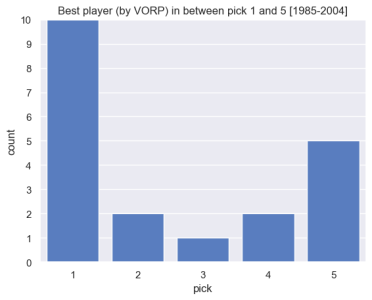
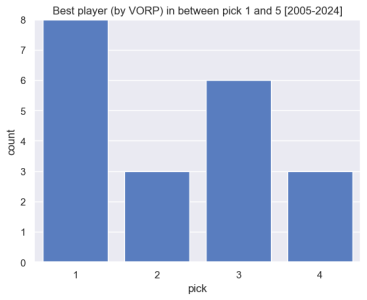
I don't think the absence of draft expertise is a new, modern phenomena either, even if you bucket picks by era, the graphs still look pretty silly.

1769919973781.png


1769920112126.png1769920096460.png

That still looks like noise to me. Perhaps in the 21st century we've narrowed it down to the top 4.

Again, it doesn't mean there's no expertise; it takes a lot of skill to be able to hit the dart board (picking the top 5). But on average, teams are not calling their shots any tighter than that. Anyone claiming otherwise can probably make some money with that knowledge somehow.
 
Last edited:
Deuce making the point in the postgame that the Wizards didn’t play any of their starters in the 4th quarter. It’s wild how blatant they are with linning.

BTW, Deuce has been on point lately. We are so lucky to have Deuce and Mo…especially during a season like this.
We late-scratched Sabonis, and played the Plowden/Stevens two-way combo for 43 combined minutes and they're still complaining about how hard the *other* team is tanking. Come on, be serious. Two can play at this game - and did, tonight.
 
We late-scratched Sabonis, and played the Plowden/Stevens two-way combo for 43 combined minutes and they're still complaining about how hard the *other* team is tanking. Come on, be serious. Two can play at this game - and did, tonight.

If Sabonis is still here by Wednesday maybe so. Fact is Christie certainly isn't trying to tank. He honestly thinks DeMar and Zach are his best shot. I get it, what coach wants to have his record? He's on the fast track to in and zipped right out of the league. We'll see what the team looks like after the deadline and how they finish the year, but this isn't an NBA level coach from the looks of it. Not by any stretch of the imagination. Unprepped after time outs. Strange rotation management. No real system or plan.
 
We late-scratched Sabonis, and played the Plowden/Stevens two-way combo for 43 combined minutes and they're still complaining about how hard the *other* team is tanking. Come on, be serious. Two can play at this game - and did, tonight.
I agree that both are playing the game, but Washington is making NO effort to camouflage it.

Deebo and Lavine were both in to close out the game. And our two-way players were required because we sent Dennis and Keon out without having Hunter here.
 
I’ve reluctantly been on board with tanking for this year because it’s a needed jumpstart to this rebuild. It’s a one and done situation for me though, I’ll be rooting for wins next year, draft odds be damned. On paper we have a bunch of winnable games left on the schedule: 2 against the Nets, 3 against the Pels, Jazz, Pacers and then games against middling teams like the Mavs, Grizz and Bulls. There is a chance we could be favored in 8-10 of the remaining games. We have lost 9 games in a row and have not separated from the pack which is insane. Right now I would project the Nets to finish with the worst record.
 
I’ve reluctantly been on board with tanking for this year because it’s a needed jumpstart to this rebuild. It’s a one and done situation for me though, I’ll be rooting for wins next year, draft odds be damned. On paper we have a bunch of winnable games left on the schedule: 2 against the Nets, 3 against the Pels, Jazz, Pacers and then games against middling teams like the Mavs, Grizz and Bulls. There is a chance we could be favored in 8-10 of the remaining games. We have lost 9 games in a row and have not separated from the pack which is insane. Right now I would project the Nets to finish with the worst record.

This is the Kings, you better already know that's the plan. Odds are after the Hunter deal this is a re-tool, not a rebuild. If it is they better start playing the young guys like it matters and not as DeMar/LaVine passing machines. They're already behind the 8 ball and just creating more and more damage if they're looking for immediate results. Now, if they continue playing the vets and/or adding more, keep that cap stuffed, and it doesn't work out. I'm putting my bet in now, the Spurs are getting a top 5 pick out of the Kings right in their prime window.
 
This is the Kings, you better already know that's the plan. Odds are after the Hunter deal this is a re-tool, not a rebuild. If it is they better start playing the young guys like it matters and not as DeMar/LaVine passing machines. They're already behind the 8 ball and just creating more and more damage if they're looking for immediate results. Now, if they continue playing the vets and/or adding more, keep that cap stuffed, and it doesn't work out. I'm putting my bet in now, the Spurs are getting a top 5 pick out of the Kings right in their prime window.

I have no expectations of a Wizards multi year style rebuild/tank. I guess I’d call what I think the Kings are going to do a hybrid rebuild/re-tool. If they trade Sabonis to the Raps for example, you’d have Keegan/Hunter/Barrett and then potentially 4 picks in this draft (our first, Raptors first, our second and the Charlotte second). Spend next year seeing what you have in those 7 young players (Nique, Max, Cardwell and the 4 draftees) and then be in a position to take a swing in the 27/28 year with all of your future picks available.
 
Look at how different the 2 teams played it out tonight.
Washington played young guys at the end, no veterans that the youngsters had to defer to.
Sac has youngster in But sharing court with Lavine and Derozan and they just defer, defer, defer……and that doesn’t even take into account how effing terrible Christie is with Carter. Carter can’t even play without fear. So dumb.
Massive difference in letting youngsters grow.
 
Look at how different the 2 teams played it out tonight.
Washington played young guys at the end, no veterans that the youngsters had to defer to.
Sac has youngster in But sharing court with Lavine and Derozan and they just defer, defer, defer……and that doesn’t even take into account how effing terrible Christie is with Carter. Carter can’t even play without fear. So dumb.
Massive difference in letting youngsters grow.


42 shots man smfh
 
Look at how different the 2 teams played it out tonight.
Washington played young guys at the end, no veterans that the youngsters had to defer to.
Sac has youngster in But sharing court with Lavine and Derozan and they just defer, defer, defer……and that doesn’t even take into account how effing terrible Christie is with Carter. Carter can’t even play without fear. So dumb.
Massive difference in letting youngsters grow.

One caveat; the Wizards just shamelessly tanked. Took Kyshawn/Bub/Bilal all off the floor and Sarr sat with a mysterious illness. And to be somewhat fair to Doug, we literally closed the game with 2 2-way players who I can't recall really seeing the NBA floor this season.

Now the usage is incredibly stupid, absolutely. Devin also had a good rhythm going, perhaps for the first time this season and Doug pulls him... to close with Stevens and Plowden? Like what?
 
Back
Top